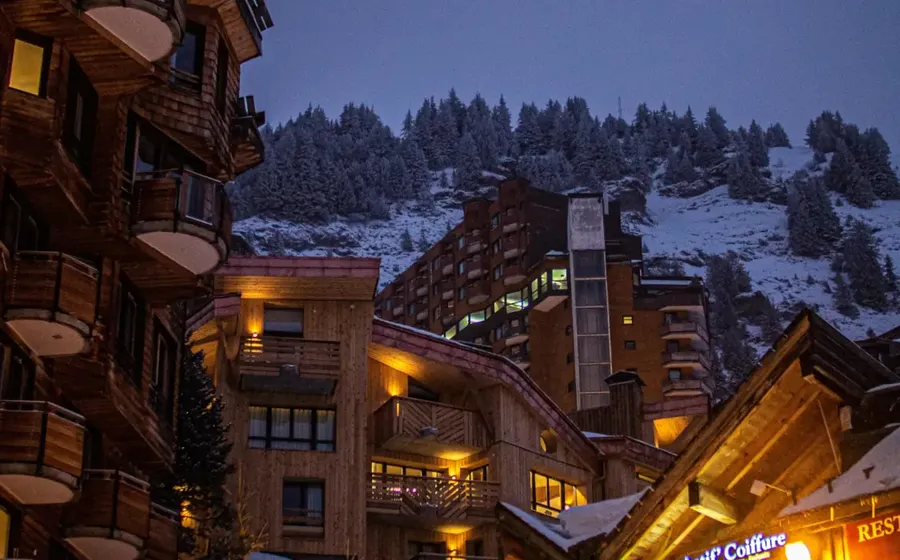
Tignes is one of France’s major high-altitude ski resorts and a core half of the Tignes–Val d’Isère ski area. Official resort information lists 300 km of linked marked pistes served by 74 lifts, with skiing extending from about 1,550 m to 3,456 m. That combination of altitude, scale and modern uplift makes Tignes a strong choice for skiers who prioritise snow reliability and a large connected domain rather than a small standalone resort.
The resort itself is spread across five main villages between roughly 1,550 m and 2,150 m: Les Brévières, Tignes 1800, Le Lavachet, Tignes le Lac and Val Claret. Each has a different feel. Les Brévières is the lowest and most traditional, Tignes 1800 is quieter and family-oriented, Le Lac is central and practical, while Val Claret sits highest and gives especially convenient access towards the Grande Motte sector. Choosing the right base matters because Tignes is not one compact village.
Intermediate skiers get particularly good value from the linked area. The piste network offers long blue and red routes between Tignes and Val d’Isère, making it possible to cover serious distance without needing expert technique. Beginners also have dedicated learning zones and gentle lifts around the resort villages, so Tignes works better for mixed-ability groups than its high-mountain reputation sometimes suggests.
Advanced and expert skiers have a much deeper range of options. The Grande Motte sector is central to Tignes’ identity, with the funicular reaching 3,032 m and the cable car reaching 3,456 m below the 3,656 m Grande Motte summit. High-altitude red and black pistes, steeper terrain and extensive off-piste possibilities give stronger skiers plenty to explore, while the linked Val d’Isère side adds further sectors and classic descents.
Snow reliability is one of the resort’s clearest strengths. Much of the skiing sits well above 2,000 m, and the Grande Motte sector provides very high-altitude terrain. The resort normally operates a long winter season, and altitude can be particularly valuable in warmer spells when lower Alpine areas are more vulnerable. Tignes also has a substantial snowmaking network to support key routes and village returns.
Tignes is practical rather than traditionally picturesque. Most bases were designed around skiing, so lift access, rentals, supermarkets, restaurants and accommodation are generally convenient. That suits families and groups who value easy logistics, although visitors seeking a classic chalet village may prefer Les Brévières or a different resort altogether. Le Lac and Val Claret also have the livelier bar and après-ski scenes.
There are trade-offs. The different villages can feel disconnected if accommodation is chosen poorly, high-altitude weather can bring wind and flat light, and the architecture in the upper resort is more functional than traditional. The full 300 km domain is also large enough that first-time visitors benefit from planning sectors rather than trying to cover everything immediately.
For a first Tignes ski trip, choose your village base according to ability, atmosphere and lift access, then use the linked area progressively. Start locally, explore the Grande Motte and Tignes sectors, and add longer days towards Val d’Isère once the group knows the network. Choose Tignes for high-altitude snow, 300 km of linked skiing, strong intermediate and advanced terrain, and straightforward ski-focused logistics.