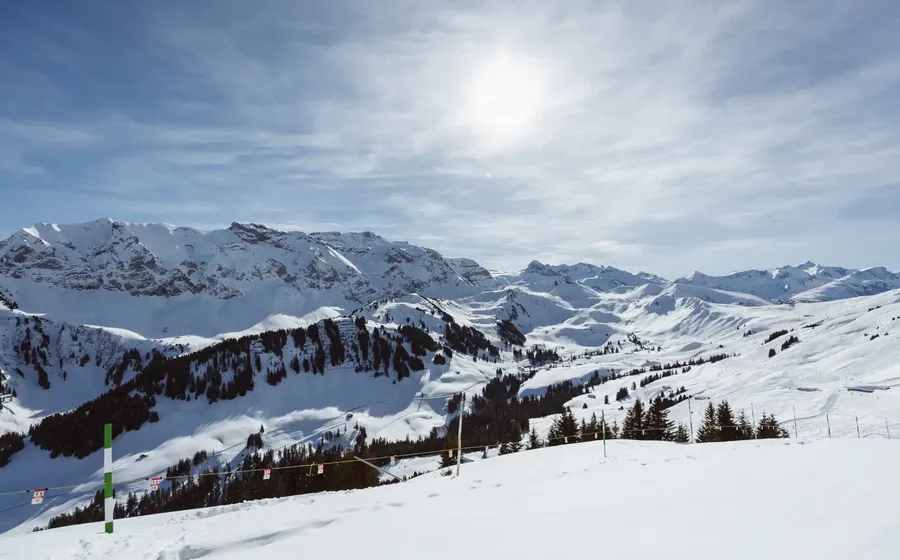
Andermatt is one of Switzerland’s strongest ski destinations for skiers who want serious mountain terrain without giving up the breadth of a large connected ski region. The resort sits at the heart of Andermatt+Sedrun+Disentis, the largest connected ski area in Central Switzerland, with around 180 km of pistes and 33 lifts reaching up to about 3,000 metres.
What makes Andermatt distinctive is the contrast between the steep, high-Alpine Gemsstock and the sunnier, more progressive skiing that runs from Nätschen across the Oberalp Pass towards Sedrun and Disentis.
The split between Gemsstock and Nätschen-Oberalp is the key to understanding the mountain. Gemsstock is the advanced side: a high, north-facing mountain above the village with mainly red and black pistes, famous freeride terrain and roughly 1,500 metres of vertical from the summit back towards Andermatt. Nätschen and the Oberalp side provide a broader mix of blue and red runs, modern lifts and the piste connection eastwards into Graubünden.
Together, those sectors give Andermatt a much more complete ski-holiday offer than its reputation as a freeride specialist might suggest.
Gemsstock is still the defining mountain for strong skiers. Official Andermatt material describes it as a freeride paradise with steep couloirs, deep powder and mainly red and black slopes. The summit rises to almost 3,000 m and the vertical drop towards the village is around 1,500 m, creating some of the longest and most sustained skiing in the region.
The Bernhard Russi Run is one of the signature pistes: a long, fast descent from high on Gemsstock through the Gurschen area that gives advanced piste skiers a genuine objective even when they are not heading off-piste.
Freeriders are one of Andermatt’s core audiences. Gemsstock has an international reputation for deep snow, steep lines and high-Alpine terrain, but that reputation should be treated with respect rather than as an invitation to ski uncontrolled terrain without preparation. Avalanche conditions can change quickly, and many of the classic off-piste lines require route knowledge.
Strong skiers who want to explore beyond marked pistes should use appropriate avalanche equipment and consider skiing with a qualified local mountain guide.
The Nätschen-Oberalp side is very different. Nätschen sits directly above Andermatt and is reached by the Gütsch Express as well as the Matterhorn Gotthard railway. From here, skiers move onto wide, sunny slopes and continue east towards the Oberalp Pass. The terrain is generally more approachable than Gemsstock, which makes this side of the resort especially useful for intermediates, families and improving skiers. It is also the crucial link into the wider Andermatt-Sedrun ski network.
The Oberalp Pass is one of the defining pieces of Andermatt’s ski geography. At 2,046 m, it connects the Andermatt side with Sedrun and the Surselva in Graubünden. In winter, the ski lifts and pistes follow the same broad corridor as the Matterhorn Gotthard Bahn, allowing skiers to move between mountain sectors while the railway acts as part of the transport network.
That combination of ski lifts and mountain train gives Andermatt-Sedrun-Disentis a different feel from a conventional single-valley ski area.
Sedrun expands the experience further. Skiers coming from Andermatt can continue across the Oberalp sector into the Sedrun side, adding more blue and red terrain, family areas and a different village base. The connection onwards towards Disentis means Andermatt is no longer best thought of as a standalone resort with one expert mountain. It is the western gateway to a large cross-regional ski area that stretches deep into the Surselva.
Disentis completes the connected Andermatt+Sedrun+Disentis network. The direct link between the Sedrun-Cuolm da Vi sector and Disentis created a continuous regional offer, so skiers can now think in terms of one large Central Swiss ski domain rather than three separate destinations. Disentis adds its own high-Alpine terrain and long vertical, while smaller family areas such as Valtgeva in Sedrun and beginner zones around Disentis give the regional ski pass more breadth for mixed-ability groups.
Intermediate skiers have much more to work with than Andermatt’s freeride image implies. The Nätschen-Oberalp-Sedrun side contains long stretches of blue and red piste, with enough connected mileage to spend full days exploring eastwards from Andermatt. Confident intermediates can also ski selected marked terrain on Gemsstock, although the mountain feels more serious and exposed than the sunny Oberalp sector. For a mixed week, alternating between the two sides gives the resort excellent variety.
Beginners should base their early ski days away from the steepest parts of Gemsstock. The Andermatt holiday region promotes family and learning areas including Realp, while the broader connected region includes beginner-friendly terrain around Sedrun and Disentis. Improving beginners can progress onto the easier pistes around Nätschen and Oberalp before attempting more demanding red runs.
This layout means Andermatt can work for families, but choosing the right lesson area matters more here than in a resort where every piste starts from one gentle bowl.
Snowboarders will find strong terrain across both sides. The wider, rolling pistes between Nätschen, Oberalp and Sedrun suit general riding and carving, while advanced riders are drawn to Gemsstock for freeride terrain and long descents. As with skiing, off-piste snowboard routes require avalanche awareness and appropriate local knowledge. The size of the connected region means snowboarders are not restricted to one mountain style during a week.
Andermatt’s snow record is another reason the resort has such a strong reputation. Official regional material describes Andermatt as one of the snowiest places in the Alps, and the high terrain around Gemsstock gives the resort a long winter profile.
The practical implication for ordinary skiers is that the resort combines high-altitude terrain with lower linked pistes, so conditions can vary significantly between mountain sectors on the same day.
The railway is unusually important to an Andermatt ski holiday. Matterhorn Gotthard Bahn stations sit directly within the winter-sports network, and the line crosses the Oberalp Pass towards Sedrun and Disentis. The same rail corridor forms part of the Glacier Express route between St. Moritz and Zermatt, which makes Andermatt relevant within a much wider Swiss mountain-travel network.
Those destinations are very different ski resorts, but their presence on the same famous railway route helps explain Andermatt’s strategic location in the Swiss Alps.
Andermatt also sits in a useful position for travellers comparing major Swiss resorts. Zermatt offers a much larger international destination built around the Matterhorn, while St. Moritz combines Engadin skiing with a highly established luxury-resort identity. Further west, Grindelwald and Wengen provide the Jungfrau region’s classic railway-and-ski-area experience.
Andermatt’s own competitive advantage is different: concentrated high-Alpine terrain on Gemsstock, a large linked east-west ski area and one of Switzerland’s strongest freeride reputations.
Zurich Airport is the most obvious major Swiss gateway for many visitors because of its rail connections, while EuroAirport Basel-Mulhouse-Freiburg can also be relevant depending on flight schedules.
Andermatt works unusually well without a car because the Swiss rail network reaches the village and continues directly through the ski region.
The village itself has changed considerably in recent years. Historic Andermatt remains visible around the older centre, while newer hotels, apartments and resort development have expanded the destination around the railway and lift infrastructure. Visitors can now choose between the character of the older village and newer accommodation close to the railway and mountain access.
For skiers, the practical decision is mainly whether easy access to Gemsstock, the Gütsch Express or the railway matters most.
Non-skiers and mixed groups benefit from the rail-connected geography. Scenic train journeys over the Oberalp corridor, winter walking, restaurants, spa facilities and excursions around the Gotthard region give people alternatives to skiing every day. The Glacier Express route also makes Andermatt an interesting base for travellers who value the journey through the Alps as much as the pistes themselves.
Andermatt is therefore strongest for skiers who want a resort with genuine mountain credibility and enough linked piste mileage for a full week. Experts and freeriders get the headline Gemsstock terrain; intermediates gain a large, sunnier network towards Nätschen, Oberalp and Sedrun; families can use the gentler learning areas across the region; and the connection to Disentis pushes the total ski offer to around 180 km.
Together, Gemsstock, the Oberalp corridor and the fully linked Andermatt-Sedrun-Disentis ski area give Andermatt a rare mix of expert terrain, substantial piste mileage and rail-connected Swiss mountain travel.